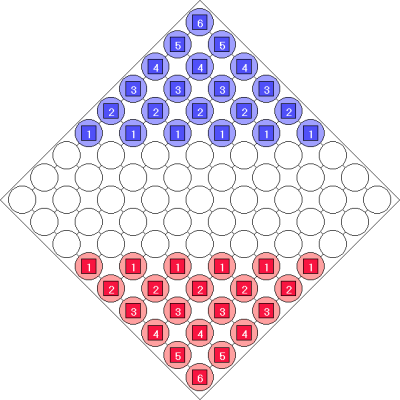
The empty squares between the enemy pieces at the beginning of the game is called the Middle Area. The starting points of the pieces form the Starting Areas for both players.
1.1 Hierarchy is a two-player strategy board game. The board consists of 9x9 round squares.
1.2 At the beginning of the game both players have in total 21 pieces with ranks 1-6 as follows
1.3 The initial position of the game is the following.
The empty squares between the enemy pieces at the beginning of the
game is called the Middle Area. The starting
points of the pieces form the Starting Areas
for both players.
2.1 Players make one move in turn. A move is either
Capturing of enemy pieces happens in two phases (moves). In the first move player attacks one of the enemy pieces. In the next move player destroys the attacked piece (removes it from the board).
If player has no legal moves, the turn passes to the opponent.
2.2 The winner of the game is the one who captures his opponents 6-ranked piece.
3.1.1 The pieces can be moved to unoccupied squares next to piece depending on the rank of the piece. E.g. 4-ranked piece can be moved 1-4 squares beside (in straight line) the piece. Exception: 1-ranked pieces can be moved two squares when they start from player's starting area.
3.2.1 In attack player connects one of his own pieces (attacking piece) to one of the enemy pieces (attacked piece). The enemy piece must be attacked before it can be destroyed (removed from the board) Player can attack to any enemy piece with any of the own pieces that fulfills the following rules.
3.2.2.1 The maximum attack distance of a piece is the sum of the ranks of the pieces next to the piece. The values of the enemy piece next to the attacking piece are counted as negative.
The attack distance is the Manhattan-distance through unoccupied squares from attacking piece to the attacked piece. The attacked piece escapes if the maximum attack distance changes after opponent´s move into the smaller than the distance between attacking and attacked pieces.
3.2.2.2 The piece can be used for attack only when it has moved to the Middle Area. However, the own pieces that affects on the attack distance may be in the Starting Area.
3.2.3.1 Player cannot move the piece that is attacked by opponent´s attacking piece.
3.2.3.2 All the pieces on the board can be attacked regardless of their position (also the pieces in the starting point can be attacked)
3.3.1 Destroying is the removing of the attacked enemy piece.
3.3.2 If possible, destroying must be done in the next move after attacking. Same piece cannot be used again for attack in the move immediately after destroying the enemy piece.
3.3.2 Destroying of the attacked piece may become impossible if a enemy piece moves to the route between the attacking and attacked pieces increasing the shortest free route between them or blocking all routes, or next to the attacking piece reducing the maximum attack distance. The attacking piece is blocked (cannot be used for attack in the next move) even if the attacked piece thus escapes.